
0
0

MAESD:一個蛋白質(zhì)序列設(shè)計的統(tǒng)一多智能體進化框架
首發(fā)時間:2025-09-30
宋澤(2001-),男,生物信息學(xué)
楊海龍 1 鄧趙紅 1鄧趙紅(1981-),博導(dǎo),(1)可信/可解釋/不確定性人工智能;(2)生物信息學(xué);(3)計算智能(模糊計算/神經(jīng)計算);(4)機器學(xué)習(xí)與數(shù)據(jù)挖掘;(5)生成式AI與大模型。
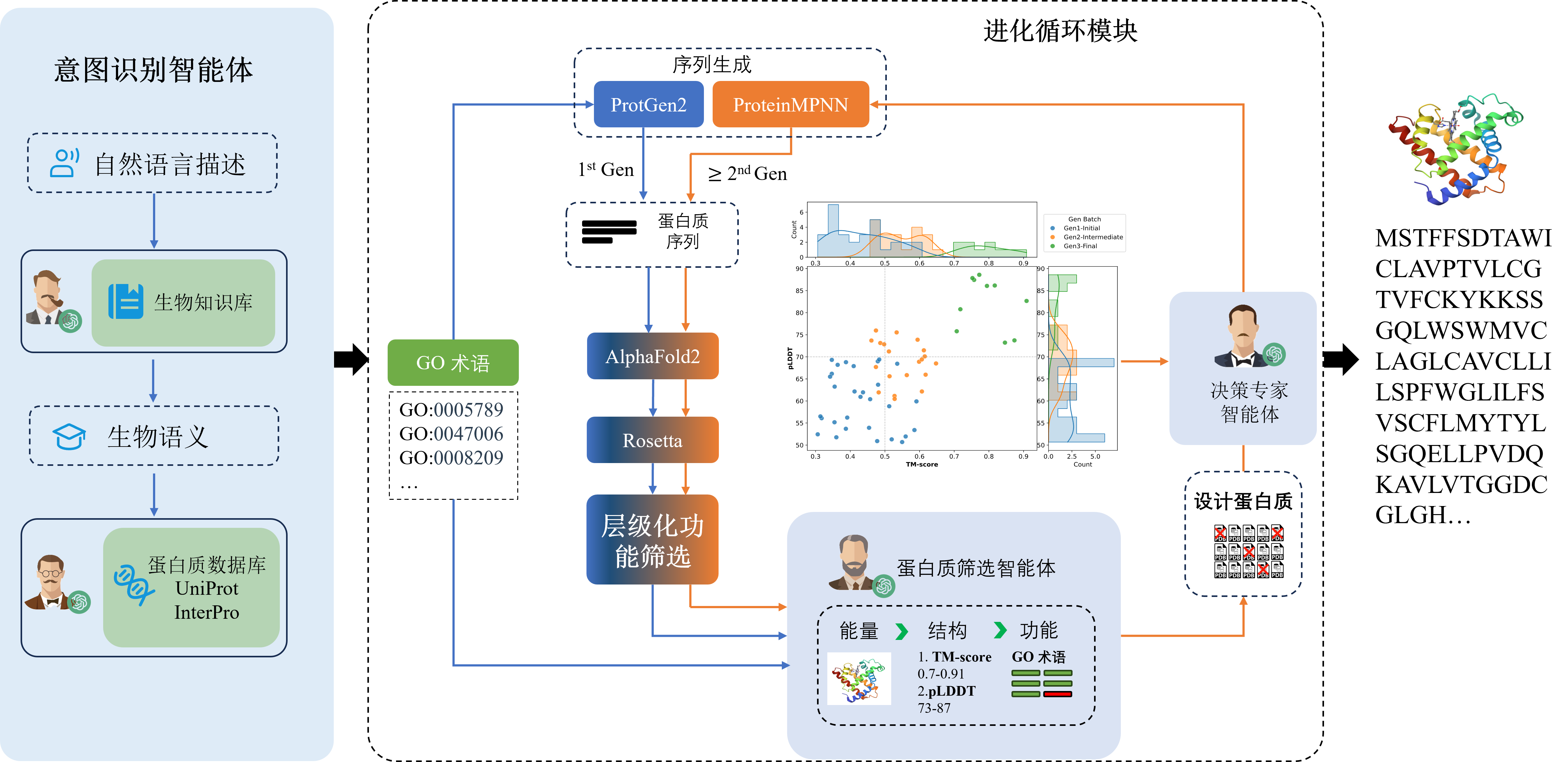
摘要:傳統(tǒng)計算蛋白質(zhì)設(shè)計需要專家級的生物學(xué)輸入來指定結(jié)構(gòu)和功能約束,這為非專業(yè)研究者設(shè)置了極高的門檻。為消除這一障礙,我們利用大型語言模型(LLMs)的最新進展--這些模型已展現(xiàn)出通過調(diào)用專業(yè)知識庫在特定領(lǐng)域進行復(fù)雜推理并輸出專家級成果的能力。本文提出MAESD(面向蛋白質(zhì)序列設(shè)計的多智能體進化框架),該框架通過自然語言指令實現(xiàn)蛋白質(zhì)設(shè)計:系統(tǒng)首先運用大語言模型解析生物學(xué)需求并提取可執(zhí)行的設(shè)計約束,繼而建立進化優(yōu)化循環(huán),最終通過序列生成與蛋白質(zhì)篩選實現(xiàn)迭代優(yōu)化。我們的框架通過多智能體協(xié)同推理,在自然語言描述與可執(zhí)行的蛋白質(zhì)設(shè)計約束之間建立動態(tài)映射,同時借助進化算法確保每一輪迭代的生物學(xué)合理性。通過融合自然語言理解與進化計算,MAESD在保持與專家設(shè)計方案相當(dāng)性能的同時,顯著降低了蛋白質(zhì)設(shè)計領(lǐng)域的專業(yè)壁壘。
關(guān)鍵詞: 蛋白質(zhì)設(shè)計 多智能體系統(tǒng) 進化循環(huán);
For information in English, please click here
MAESD: A Unified Multi-Agent Evolutionary Framework for Protein Sequence Design
宋澤(2001-),男,生物信息學(xué)
Yang Hailong 1 Deng Zhaohong 1鄧趙紅(1981-),博導(dǎo),(1)可信/可解釋/不確定性人工智能;(2)生物信息學(xué);(3)計算智能(模糊計算/神經(jīng)計算);(4)機器學(xué)習(xí)與數(shù)據(jù)挖掘;(5)生成式AI與大模型。
Abstract:Computational protein design traditionally requires expert-level biological inputs to specify structural and functional constraints, creating significant barriers for non-specialists. To bridge this gap, we leverage recent advances in large language models (LLMs) that demonstrate their capability to perform complex reasoning in specialized domains by leveraging knowledge bases to produce expert-grade outputs. In this paper, we present MAESD(Multi-Agent Evolutionary framework for protein Sequence Design), a framework for protein design via natural language instructions. The system first employs large language models to interpret biological requirements and extract actionable design constraints, then establishes an evolutionary optimization loop , and finally iteratively refines sequences through generation and protein screening. Our framework establishes a dynamic mapping between natural language specifications and executable protein design constraints via collaborative multi-agent reasoning, with evolutionary optimization ensuring biological plausibility at each iteration. By integrating natural language understanding with evolutionary computation, MAESD significantly lowers the expertise barrier for protein design while achieving performance comparable to expert-crafted solutions.
Keywords: Protein Design, Multi-Agent Systems, Evolutionary Loop
基金:
論文圖表:
引用


No.****
動態(tài)公開評議
共計0人參與
勘誤表
MAESD:一個蛋白質(zhì)序列設(shè)計的統(tǒng)一多智能體進化框架
中國科技論文在線 版權(quán)所有
網(wǎng)站地圖|
在線首頁|
在線簡介|
服務(wù)條款|
聯(lián)系我們

京公網(wǎng)安備 11040202430024號 京ICP備15006316號-2| 網(wǎng)絡(luò)出版服務(wù)許可證 (總)網(wǎng)出證(京)字第083號 | 文保網(wǎng)安備案號:1101080066
 提示
提示


 .txt
.txt .ris
.ris .doc
.doc
評論
全部評論