
陸地棉苗期耐鹽相關基因 GhISR3 的克隆及亞細胞定位分析
首發時間:2023-05-26
田嘉豪(1998-),男,在讀碩士
魏警坤 1 吳廷荷 1 李志坤 1李志坤(1979-),男,教授、碩導,棉花全基因組選擇育種
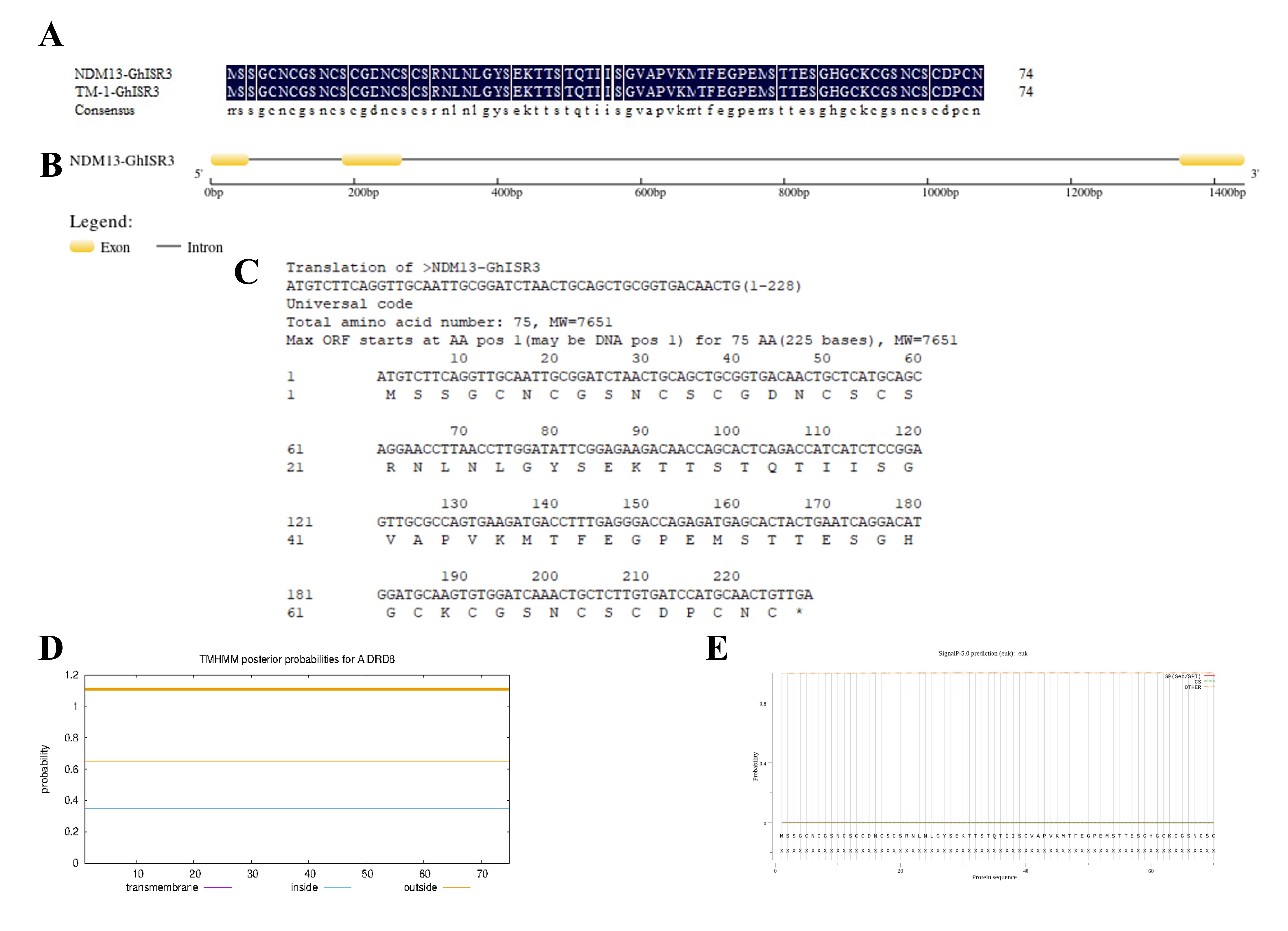
摘要:土壤鹽漬化是農業生產中重要的環境脅迫之一,嚴重影響著作物的產量和品質。相較主要的糧食作物,棉花具有更高的耐鹽性,也被稱為鹽堿地種植的先鋒作物。因此,發展鹽堿地植棉可以有效緩解"糧棉爭地"矛盾,也是我國棉花產業結構調整的重要方向,更是"持續推動由主要治理鹽堿地適應作物向更多選育耐鹽堿植物適應鹽堿地轉變"的具體措施之一。但棉花的不同發育時期對鹽脅迫敏感性有較大差異,特別是苗期對鹽脅迫更加敏感,因此挖掘棉花苗期耐鹽相關基因并解析其耐鹽機制對改良棉花耐鹽性、發展鹽堿地植棉更具理論和應用價值,但相關研究進展緩慢。本研究在前期鹽脅迫下6個棉花品種苗期蛋白組測序基礎上,克隆了一個差異蛋白 GhISR3,該基因的開放閱讀框包含 228bp,編碼75個氨基酸。基因結構分析顯示該基因存在3個外顯子和2個內含子。蛋白產物預測分析顯示該基因編碼蛋白無信號肽、無跨膜結構域,等電點為4.763。保守域分析顯示GhISR3屬于金屬硫蛋白家族蛋白。亞細胞定位顯示GhISR3定位于細胞核。?
For information in English, please click here
Cloning and Subcellular Localization Analysis of GhISR3, a Salt Tolerance Related Gene in Upland Cotton Seedlings
田嘉豪(1998-),男,在讀碩士
WEI Jingkun 1 WU Tinghe 1 LI Zhikun 1李志坤(1979-),男,教授、碩導,棉花全基因組選擇育種
Abstract:Soil salinization is one of the important environmental stresses in agricultural production, which seriously affects the yield and quality of crops. Compared to the main food crops, cotton has higher salt tolerance and is also known as the pioneer crop for planting in saline alkali soil. Therefore, the development of cotton planting in saline alkali land can effectively alleviate the contradiction of "grain and cotton competing for land", and is also an important direction for the adjustment of China\'s cotton industry structure. It is also one of the specific measures to "continuously promote the transformation from mainly treating saline alkali land to adapting crops to more breeding of salt alkali tolerant plants to adapt to saline alkali land". However, there are significant differences in the sensitivity of cotton to salt stress at different stages of development, especially during the seedling stage, which is more sensitive to salt stress. Therefore, exploring salt tolerance related genes in cotton seedlings and analyzing their salt tolerance mechanisms has more theoretical and practical value for improving cotton salt tolerance and developing cotton planting in saline alkali soil. However, the progress of related research is slow. This study cloned a differential protein GhISR3 based on proteome sequencing of six cotton varieties during seedling stage under salt stress in the early stage. The open reading frame of this gene contains 228 bp and encodes 75 amino acids. Gene structure analysis shows that the gene has 3 exons and 2 introns. The protein product prediction analysis showed that the protein encoded by the gene had no signal peptide and transmembrane domain, and its isoelectric point was 4.763. Conservative domain analysis shows that GhISR3 belongs to the metallothionein family of proteins. Subcellular localization shows that GhISR3 is located in the nucleus.)
Keywords: Upland cotton Salt resistance Bioinformatics analysis Gene cloning.
基金:
論文圖表:


引用


No.****
動態公開評議
共計0人參與
勘誤表
陸地棉苗期耐鹽相關基因 GhISR3 的克隆及亞細胞定位分析
中國科技論文在線 版權所有
網站地圖|
在線首頁|
在線簡介|
服務條款|
聯系我們

京公網安備 11040202430024號 京ICP備15006316號-2| 網絡出版服務許可證 (總)網出證(京)字第083號 | 文保網安備案號:1101080066
 提示
提示


 .txt
.txt .ris
.ris .doc
.doc
評論
全部評論